Body horror books make the body itself the source of terror, turning transformation, mutation and the loss of bodily autonomy into the engine of dread. This is a curated list of recommended titles, from literary classics to transgressive modern novels, and we include The Crimson Echoes Of Oakhaven (Book 1) from our own catalog.
TL;DR:
- Choose The Metamorphosis or The Vegetarian for milder unease; try Annihilation, Parasite, or The Cipher for moderate intensity, and The Troop for graphic horror.
- Check content notes for injury, medical procedures, pregnancy or childbirth horror, eating disorders, images of people harming themselves, sexual violence, and harm to children.
- Choose Womb City or You Weren’t Meant to Be Human for themes of technology, identity, and bodily autonomy; The Troop focuses on parasitic mutation.
- Read a preview chapter before buying, especially for The Crimson Echoes Of Oakhaven, and stop if a theme crosses your personal limit.
Table of Contents
- What is body horror, and how is it different from other horror?
- What techniques and themes should you expect?
- Which body horror books should you read?
- How do you pick the right body horror book for you?
- Why can you trust this list?
- How has body horror evolved in literature?
- Which authors shaped the subgenre?
- What symbols and motifs show up again and again?
- Why does body horror captivate readers?
- How does body horror differ in books and in film?
- What societal fears does body horror reflect?
- Editor perspective: why does body horror resonate?
- Where can you preview and buy body horror e-books?
- FAQ
- Sources
What is body horror, and how is it different from other horror?
Body horror is defined by the graphic, often visceral transformation, mutilation or violation of the human form, which turns the body into something alien or grotesque. According to genre analyses on Wikipedia, it commonly works as an allegory for social issues such as bodily autonomy, capitalism and technological encroachment. The fear is not what lurks outside you. It is what is happening to you, in your own flesh, while you can do nothing about it.
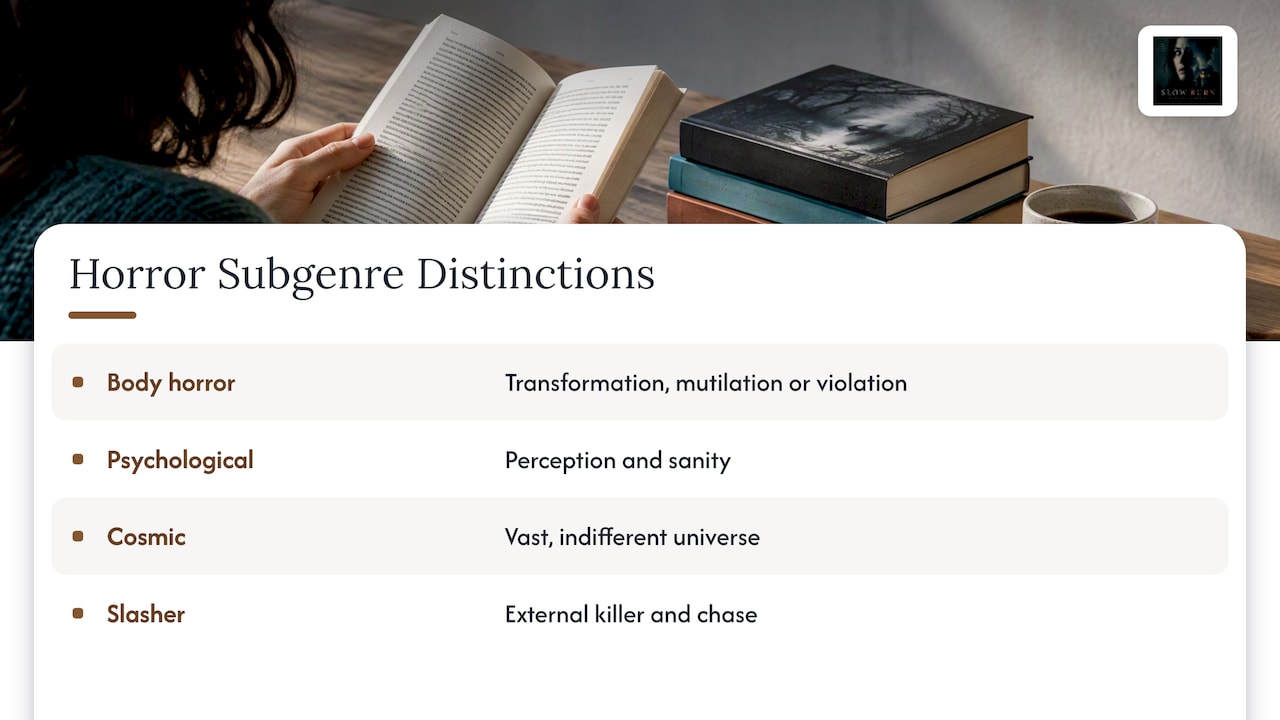
That separates it from its neighbors. Psychological horror works on perception and sanity, and the threat may never touch the body at all. Cosmic horror makes the universe too vast and indifferent for human comprehension. Slasher fiction centers on an external killer and a chase, and major outlets note that slasher traditions follow their own conventions, which shape reader expectations differently than body horror does. Plenty of great books blend these modes, but body horror keeps the flesh at the center.
Two examples help anchor the definition. Franz Kafka’s The Metamorphosis is the classic: a man wakes as an insect, and the horror lies in how his family and his own body slowly stop treating him as human. Han Kang’s The Vegetarian is the modern literary example, in which one woman’s refusal to eat meat becomes a transformation that her family, and eventually her body, cannot contain. Both show how a changed body exposes everything the people around it were trying not to see.
What techniques and themes should you expect?
Body horror relies on a handful of recurring devices, and knowing them helps you judge intensity before you commit.
Transformation is the foundation: a body changes shape, species or substance. Invasion adds something foreign, such as a parasite, an infection or an implant. Mutation makes the change permanent and often progressive. Grotesque detail is the sensory layer, with prose that lingers on texture, fluid and smell. Underneath all four runs an escalation of dread: the protagonist’s loss of bodily control maps directly onto narrative tension, so each chapter takes a little more from them. Books built on that slow loss tend to leave a deeper mark than books built on a single shocking scene.
The themes are rarely random. Writers use the body to explore bodily autonomy, capitalism and technology, and critics note that recent entries keep pushing the genre’s boundaries. Scholarship on the female Gothic body argues that women’s bodies have long been depicted as sites of both monstrosity and power, a lens that informs a good deal of contemporary work.
Trigger warnings matter here. Common content includes graphic injury, medical procedures, pregnancy and childbirth horror, eating disorders or food aversion, self-harm imagery, sexual violence, and harm to children. If any of these are hard for you, check a book’s content notes before you start, and read the preview chapter first.
Which body horror books should you read?
Here are recommended titles, mixing classics, literary prize territory and modern transgressive work. Each entry says what the book is, why it counts as body horror and who it suits best.
-
The Metamorphosis by Franz Kafka. A short novella about a traveling salesman who wakes up transformed into a giant insect. The body horror is quiet and relentless: the physical change is established from the start, and the story follows its social and emotional consequences. Best for readers new to the subgenre who want a brief, foundational text.
-
The Vegetarian by Han Kang. A woman stops eating meat after a disturbing dream, and her family responds with escalating violence while her body changes in ways that blur human and plant. It is a widely cited modern example and appears among The Guardian’s notable body horror novels, noted for combining literary merit with disturbing content. Best for readers who prefer prize-caliber prose and allegory over gore.
-
The Troop by Nick Cutter. Five boys and a scoutmaster on a remote island meet a starving stranger carrying something parasitic. The body horror is explicit and sustained, with infection spreading through bodies and group loyalty alike. Best for readers who want visceral, high-intensity horror and can handle harm to young characters.
-
Womb City by Tlotlo Tsamaase. A near-future story of a woman bound to a surveillance-saturated society where bodies are controlled and commodified, highlighted by critics as pushing the genre’s boundaries. The body is the site of both horror and resistance. Best for readers who like speculative fiction with a political edge.
-
You Weren’t Meant to Be Human by Andrew Joseph White (2025). A recent entry the same critics point to as expanding what the subgenre can do, treating bodily transformation as a way to talk about identity and autonomy. Best for readers who want a contemporary voice and a story where the flesh is also a battleground for selfhood.
-
The Cipher by Kathe Koja. Two lovers discover a strange hole in a storage-room floor, and its influence rewrites their bodies and relationship. Named among top-tier recommendations in the research behind this list, it is a landmark of surreal, transgressive horror. Best for readers who enjoy dread that is hypnotic rather than splattery.
-
The Crimson Echoes Of Oakhaven (Book 1). The first book in the series we carry in our catalog, a horror e-book you can sample before buying. We list it here as part of our own selection, and its fit depends on your taste for slow-building, atmospheric dread, which is why we encourage reading the preview chapter first. Best for readers who like to try a new author with low risk. You can find it on its product page.
-
Frankenstein by Mary Shelley. The ancestor of the form: a body assembled from parts, a creator horrified by his own work. The horror lies in what flesh can be made to do and who gets to decide. Best for readers who want to see the roots of the subgenre.
-
The Fly (short story) by George Langelaan. The story behind the famous film follows a scientist whose teleportation experiment fuses him with an insect, and it shows how a few pages can carry a complete transformation arc. Best for readers who want a short, sharp, classic entry.
-
Annihilation by Jeff VanderMeer. An expedition into a zone where nature rewrites everything, including the people sent to study it. Bodies change slowly and strangely, closer to wonder than gore. Best for readers drawn to weird fiction and unsettling beauty.
-
Parasite by Mira Grant. A medical thriller premise in which engineered tapeworms live inside nearly everyone, and the question is what they want. It leans on infection and medical dread more than extreme imagery. Best for readers who like science-driven horror with a thriller pace.
-
Her Body and Other Parties by Carmen Maria Machado. A short story collection in which women’s bodies are dissected, erased and rewritten by the world around them. The horror is intimate and often feminist in its aim. Best for readers who prefer short formats and literary experimentation over a single long descent.
Prize recognition shows how far the subgenre has traveled. The Booker Prizes have run a feature on body horror books nominated for the Booker and International Booker, which shows the crossover into literary prestige.
How do you pick the right body horror book for you?
Start with your tolerance, then match theme and format.
- Mild tolerance: Choose narrative or psychological edge over graphic imagery. The Metamorphosis and The Vegetarian disturb through situation more than gore. The New York Times beginner guide advises starting with milder or classic works and names Shirley Jackson, Victor LaValle and T. Kingfisher as accessible entry points.
- Moderate tolerance: Try Annihilation, Parasite or The Cipher, where the transformation is vivid but the prose keeps you at a slight distance.
- Extreme tolerance: Go to The Troop, where graphic transgression is part of the design.
- By theme: Pick Womb City or You Weren’t Meant to Be Human for political and social allegory, The Troop for visceral mutation, and The Metamorphosis for surreal metamorphosis.
- By format: Choose a novella or a story collection such as Her Body and Other Parties if you want intensity in small doses, and a full novel if you want sustained dread.
Pro Tip: Always read the preview chapter before buying an e-book, and stop reading the moment a theme crosses your personal line. We offer previews so you can try a book’s voice and intensity first, and our guide to finding psychological horror by mood with preview chapters walks through the practice.
Why can you trust this list?
This list leans on public critical evidence rather than our taste alone. The Guardian’s roundup of five notable body horror novels highlights The Vegetarian as a major example, and the Booker Prizes’ coverage of nominated body horror shows the subgenre reaching literary prestige. Coverage at the University of Rochester points to recent releases such as Womb City and You Weren’t Meant to Be Human as pushing the genre forward.
For transparency: we specialize in digital horror, thriller and suspense e-books, and we let readers preview exclusive chapters before purchase. That is why this list pays so much attention to tolerance and entry points. We want you to choose with your eyes open.
How has body horror evolved in literature?
Body horror did not start with modern paperbacks. Gothic fiction was already preoccupied with flesh, and scholarship on Gothic corporeality links depictions of persecuted bodies to wider institutional and social violence. In that tradition the body works as a text on which a society writes its fears.
Gothic fiction gave the subgenre foundational images. Frankenstein made the assembled body a moral problem, and later Victorian tales of doubles, diseases and degeneration kept the flesh unstable. Kafka stripped the apparatus away. There is no laboratory in The Metamorphosis, only a body that has changed and a family that must live with it.
Later writers pushed toward explicit, transgressive treatments, while pulp and genre fiction supplied infections, parasites and mad science. In recent years, literary fiction has embraced the form, with prize committees and critics treating books like The Vegetarian as serious art. Contemporary authors now use it for questions about identity, surveillance and autonomy, which is why the subgenre keeps finding new readers.
Which authors shaped the subgenre?
A few names recur whenever critics trace the line. Mary Shelley established the creator and the created body as a horror engine. Franz Kafka showed that a single physical change, treated without explanation, can carry a whole social critique. Their influence runs through nearly everything that followed.
Among modern writers, Han Kang demonstrated that body horror can sit comfortably inside literary fiction and prize conversations. Nick Cutter proved the commercial appetite for unflinching, parasitic horror. Kathe Koja helped define the hypnotic, transgressive strain, in which bodies change under the influence of something never fully explained. Jeff VanderMeer brought a weird-fiction sensibility, where transformation is as strange and beautiful as it is frightening.
Newer voices are widening the field. Tlotlo Tsamaase and Andrew Joseph White, both singled out by critics, bring perspectives on technology, identity and bodily autonomy that earlier generations rarely centered. Carmen Maria Machado’s story collection shows how the form can be bent toward intimate, feminist ends. Together these writers show that the subgenre is less a fixed formula than a toolkit.
What symbols and motifs show up again and again?
Certain images recur because they work. Insects and parasites stand for what lives off us or inhabits us without consent, from Kafka’s insect to Cutter’s infection. Skin is the border between self and world, so tearing, shedding or replacing it signals a crisis of identity. Mouths and eating carry questions of appetite, control and refusal, which is central to The Vegetarian.
Pregnancy and wombs appear whenever a story is about being used or occupied by something else, and Tsamaase’s title puts the motif up front. Doors, holes and thresholds mark the point where something enters the body or the world, as in The Cipher. Mirrors and the moment of recognizing your changed reflection give the reader a front-row seat to the protagonist’s horror.
Medical settings are another favorite, with surgeries, tests and diagnoses showing the body treated as an object. Our guide to medical thriller books you can sample before you buy covers the thriller side of that territory. Because scholars read persecuted bodies as stand-ins for institutional violence, many of these motifs carry a second meaning: whoever controls the body in the story usually stands for someone who controls bodies in life.
Why does body horror captivate readers?
Part of the pull is psychological. Fear in a safe setting lets you rehearse your worst anxieties, and nothing is more personal than the body. Reading about a transformation you cannot stop is a controlled way to feel what it would be like to lose control, and then close the book.
Part of it is cultural. Because body horror functions as an allegory for societal trauma and bodily autonomy, readers often find their own pressures reflected in the monstrous. Novelist Heather Parry frames the genre as a vehicle for social critique rather than merely gore, and editor Natasha Qureshi observes that contemporary pressures around bodily autonomy and AI are expanding its relevance.
There is also craft. The best books use an escalation of dread, so the protagonist’s slipping control becomes the engine of the plot. Readers who finish them often describe a lingering unease, a kind of physical awareness that follows them for days. That mix of discomfort, meaning and momentum is why people keep coming back, even when they swear the last book was too much.
How does body horror differ in books and in film?
Film shows; books make you imagine. A camera can hold on a transformation and force you to look, which is why cinema leans on practical effects, makeup and shock. A page cannot do that, so prose body horror depends on voice, detail and the reader’s own mind, which is often more personal than anything on screen.
Interiority is the biggest difference. A novel can place you inside the changing body, with its sensations, its denial, and its slow understanding. The Metamorphosis works largely because we stay close to a man processing his situation, and The Vegetarian is told through the people around its protagonist, so the strangeness stays out of reach. Film struggles to match that closeness.
Pacing differs too. A movie delivers its dread in a continuous viewing, while a book lets you set it down, which can intensify the effect because the dread follows you into the rest of your day. Reader expectations also differ across media, since genre roundups note that cinema and literature develop distinct conventions. If film body horror is too graphic for you, books are often an easier way in, because you control the intensity of every image.
What societal fears does body horror reflect?
Body horror tends to track whatever a culture is anxious about, because the body is where those anxieties land. Questions of bodily autonomy, capitalism and technological encroachment show up again and again, as bodies are controlled, commodified or invaded.
Medical and reproductive control are constant subjects, from forced procedures to the sense that your own body is not entirely yours. Scholarship on the female Gothic body shows how women’s bodies have long carried these fears. Infection and contagion stories channel worries about public health and the stranger who might carry something. Technology stories, such as Tsamaase’s surveillance-heavy future, ask what happens when systems can see, track and alter us.
Identity is a growing theme as well. Recent novels use transformation to explore who gets to decide what a body is allowed to be, and the pressure of AI is giving the old fears new shapes. When you read body horror critically, ask what the change in the body stands in for. The answer is usually a fear the author could not state any other way.
Editor perspective: why does body horror resonate?
I read body horror for the same reason I flinch at it: nothing else makes the stakes so personal. A haunted house can be left, but a body cannot. That is why the best books in this list stay with me long after the plot has faded, and why they feel more relevant every year as technology and politics keep pressing on questions of who controls our flesh. My advice is simple. Sample first, read slowly, and put the book down the moment it stops feeling like a challenge and starts feeling like harm.
— lorraine
Where can you preview and buy body horror e-books?
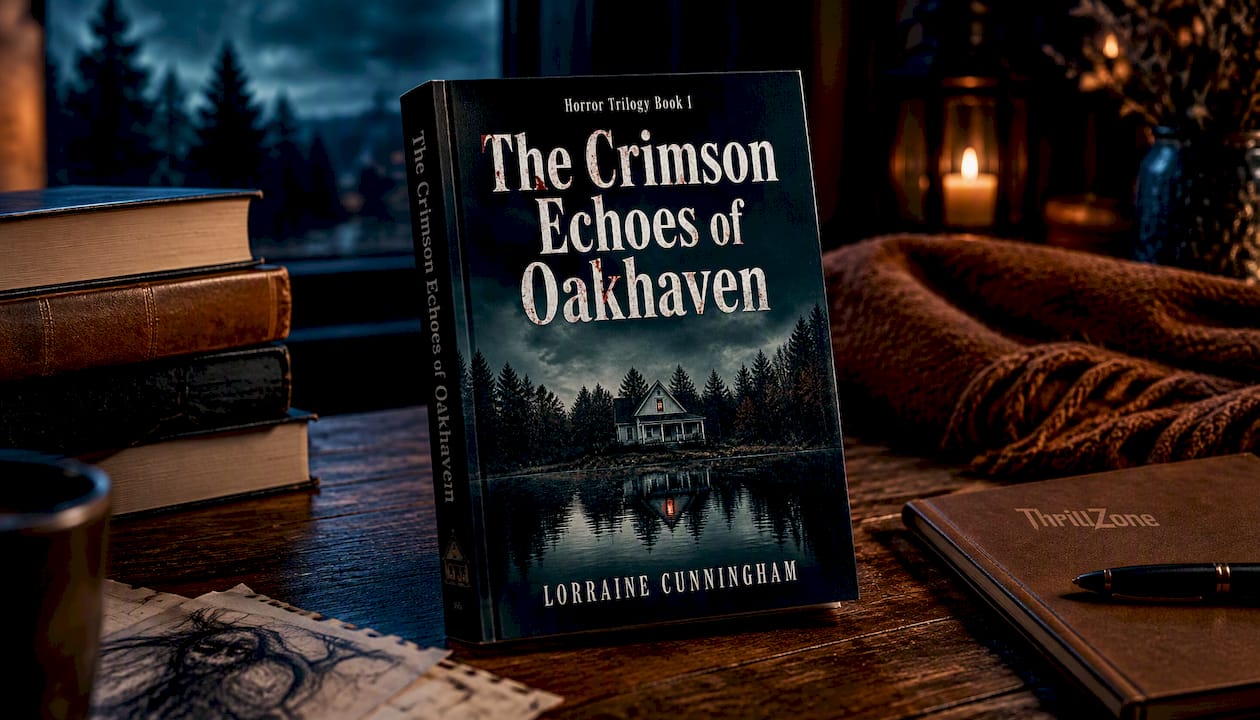
We let you read exclusive preview chapters before you buy, so you can test a book’s voice and intensity. Our featured title, The Crimson Echoes Of Oakhaven (Book 1), is part of the list above, and you can sample it today. To browse more, head to our horror collection, explore our thriller collection, or see the full range of e-books. Pick a preview, see how it feels, and buy only when you are ready.
FAQ
What are some good smutty horror books?
Body horror and erotic horror overlap, but they are not the same thing. Sexual content in this subgenre is usually transgressive rather than romantic, as in Kathe Koja’s The Cipher, where obsession and bodily change intertwine. Check content notes before reading, because the material can be intense.
What are some good books about the human body?
For fiction that puts the body at the center, try Han Kang’s The Vegetarian, Franz Kafka’s The Metamorphosis and Carmen Maria Machado’s Her Body and Other Parties. The Guardian roundup is another good starting point.
What qualifies as body horror?
Body horror features the graphic transformation, mutilation or violation of the human form, usually as a source of fear and often as an allegory for social issues such as bodily autonomy. If the body itself is the threat or the victim, the book qualifies.
What is the darkest Stephen King book?
Darkness is subjective, and readers disagree widely. For body-focused dread in King’s work, readers often point to his more visceral novels and stories, but if you want a beginner-friendly path into horror more broadly, the New York Times guide recommends starting with milder or classic authors.
Sources
- En
- Rochester
- Six body horror books nominated for the Booker and International Booker Prize | The Booker Prizes
- Five of the best body horror novels | Books | The Guardian
Recommended
- 12 Black Horror Authors to Read First
- Folk Horror Books: Classics, New Regions, and a Preview Chapter
- Pick Cosmic Horror in 5 Minutes: Formats and Previews for New Readers
- Find the Right Psychological Horror Books by Mood, Preview Chapters