If you love Stephen King, start with Tananarive Due, Ronald Malfi, John Langan, Philip Fracassi, and Joe Hill, and pick up Due’s The Reformatory first. These writers share King’s gift for character-first dread, small-town menace, and prose that reads like a friend telling you something terrifying at 2 a.m. Below, we break down the full shortlist, a starter book for each, and how to choose your next read with confidence.
TL;DR:
- Readers who loved It or The Stand should try Due or Langan for folklore, broad scope, and slow reveals; Misery fans should choose Fracassi’s Gothic.
- Ronald Malfi’s Come with Me suits readers who prefer quiet, grief driven suspense, as memory and obsession build psychological dread instead of action.
- Philip Fracassi’s Gothic centers on a novelist whose ambition threatens his sanity, making it a close fit for readers drawn to writer in peril horror.
- Eric LaRocca’s Things Have Gotten Worse Since We Last Spoke is shorter and more transgressive, suited to readers seeking rawer horror than King’s mainstream novels.
- Read the first ten pages before buying: a direct, conversational narrator and domestic detail can reveal whether the book’s voice and pacing suit you.
Table of Contents
- 1. Authors Like Stephen King You Should Read Next
- 2. Why These Authors Feel Like Stephen King
- 3. Meet Lorraine, Your Curator for This List
- 4. How to Pick Which Similar Author or Book to Try Next
- 5. What Makes Stephen King’s Style Distinct
- 6. Which Horror Subgenre Matches Your Taste
- 7. Exploring Crossover Authors for Blended Genres
- 8. What This List Gets Right That Most Don’t
- Try Preview Chapters First on Our Shelves
- FAQ
- Sources
1. Authors Like Stephen King You Should Read Next
Each author below earns a spot because of a specific match to something King does well: voice, setting, pacing, or the particular flavor of dread. We paired each with one starter book and a quick read on who in King’s audience will love them most.
-
Tananarive Due, start with The Reformatory. Due writes historical horror that blends real injustice with supernatural menace, echoing the moral weight King brings to books like The Shining.
- King fans will recognize a ghost story grounded in grief and systemic cruelty rather than cheap scares.
- Best for readers who loved the social conscience running through It and The Green Mile.
-
Ronald Malfi, start with Come with Me. Malfi writes grief-soaked suspense where the horror creeps in sideways, much like King’s slower-burn novels.
- King fans will recognize a narrator who processes loss in real time, with dread building through memory and obsession.
- Best for readers who prefer King’s quieter, character-driven work like Bag of Bones over his action-heavy novels.
-
John Langan, start with The Fisherman. Langan specializes in cosmic horror wrapped in folksy, conversational narration, a structure that rewards patience the way King’s longer novels do.
- King fans will recognize nested stories, local legend, and a narrator who sounds like he’s talking to you across a diner table.
- Best for readers who loved the slow reveal and cumulative dread of It or Pet Sematary.
-
Philip Fracassi, start with Gothic. Fracassi writes directly in the tradition of the cursed writer and the price of ambition, a theme King returns to often. His novel Gothic wears that influence openly, channeling the writer-in-peril plot King fans know from Misery and The Shining, with the same attention to character dread.
- King fans will recognize the “creator as victim” setup and a slow unraveling of sanity tied to creative obsession.
- Best for readers drawn to King’s stories about writers losing their grip on reality.
-
Joe Hill, start with Heart-Shaped Box. Hill writes with a voice that blends pulpy horror instincts with literary structure, and the family resemblance to King’s style is impossible to miss once you know it.
- King fans will recognize sharp dialogue, rock-and-roll grit, and supernatural objects that carry real menace.
- Best for readers who want King’s early paperback energy updated for a contemporary audience.
-
Eric LaRocca, start with Things Have Gotten Worse Since We Last Spoke. LaRocca writes shorter, rawer horror that leans into transgressive and visceral territory, a tone King explored in his grittier early work. In a PopHorror interview, LaRocca discusses writing deliberately uncomfortable, transgressive fiction, a useful signal for readers who want horror with teeth.
- King fans will recognize the willingness to go to uncomfortable emotional places without flinching.
- Best for readers who loved King’s rawer early novels like Carrie and want something with a harder edge and a shorter page count.
For readers who gravitate toward interior, mood-driven horror, our guide to psychological horror books by mood breaks down titles with preview chapters so you can match tone before buying. And if you want to taste several of these substyles without committing to a full novel yet, our one-sitting horror novella roundup is built for exactly that.
Stephen King himself has sold more than 400 million books worldwide, a scale that explains why so many writers work in his shadow and why finding the right substyle match matters more than finding a generic “King clone.”
2. Why These Authors Feel Like Stephen King
The resemblance isn’t accidental. These writers share a handful of specific techniques that readers can learn to spot on their own, long before they finish a first chapter.
- Character interiority: King spends pages inside a character’s head before anything scary happens, and Ronald Malfi does the same, letting grief and obsession build the dread.
- Conversational voice: King’s narrators sound like real people telling a story out loud, a quality John Langan captures through nested, folksy narration in The Fisherman.
- Small-town setting: Domestic, specific places with real history ground the horror, something Tananarive Due uses to devastating effect in The Reformatory.
- Writer-in-peril or creator-as-victim: King returns to this often, and Philip Fracassi’s Gothic channels it directly through a novelist’s unraveling ambition.
- Moral and social subtext: The best horror says something beyond the scare, a quality critics point to when they compare King’s cultural role to Charles Dickens, noting that his blend of conversational narration and social realism is genuinely hard to copy.
You can spot these in a blurb or a first chapter: look for a narrator who talks directly to you, local names and places instead of generic settings, and stakes that start at home before they go cosmic.
3. Meet Lorraine, Your Curator for This List
This list comes from a reading life built around horror, thriller, and suspense, curated specifically for readers who already know what King does well and want it again without the guesswork.
- Lorraine curates these recommendations with an eye toward matching reading experience, not just genre labels, a distinction that matters more than most “best horror authors” lists admit.
- Every pick above connects to a specific King strength (voice, setting, theme) rather than a vague “if you like scary books” logic.
- We offer a preview-chapter feature that lets you read the opening pages of select titles before paying, which lowers the risk of a purchase that doesn’t match your taste.
Pro Tip: Use the preview chapter to check the narrator’s voice and pacing in the first few pages. If it reads like someone talking to you rather than describing events at a distance, that’s a strong King-style signal.
4. How to Pick Which Similar Author or Book to Try Next
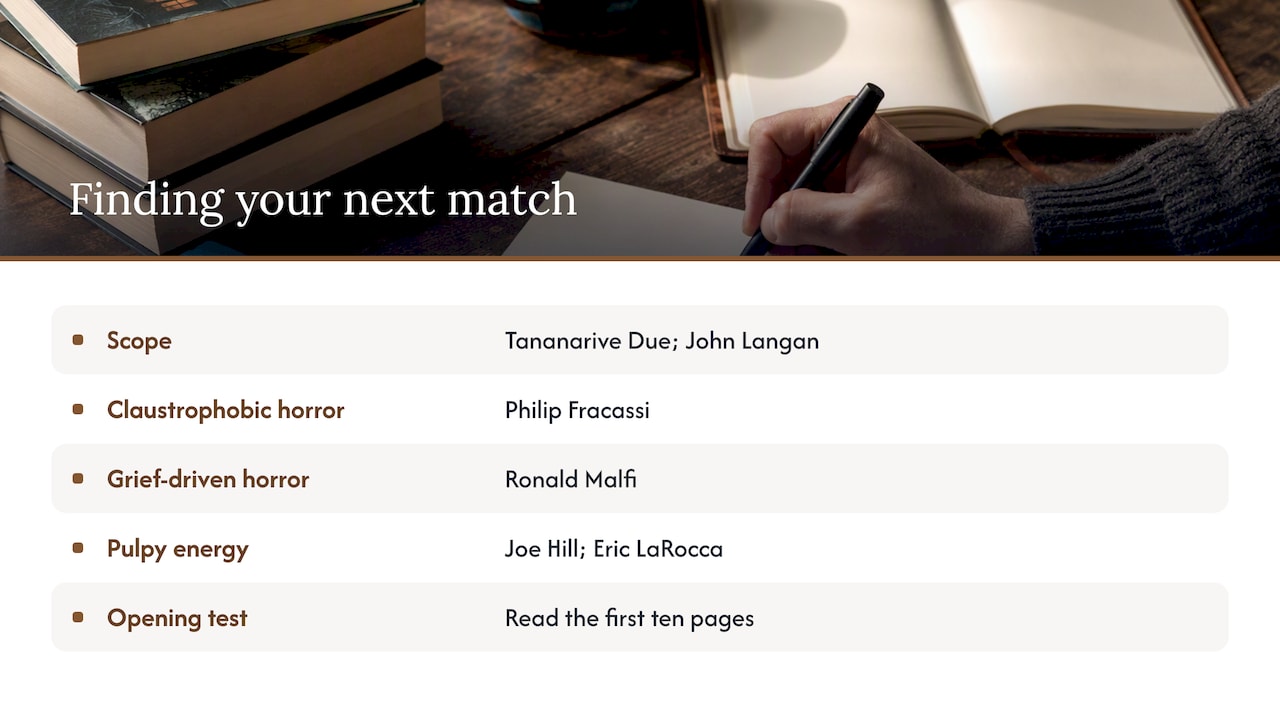
Start with what you loved most about the King book that hooked you. If it was It or The Stand, you want scope and found-family dynamics, so Tananarive Due or John Langan will feel closer than a shorter, punchier writer. If it was Misery or The Shining, you want claustrophobic, character-trapped horror, which points you toward Philip Fracassi.
If you prefer King’s quieter, grief-driven side (Bag of Bones, Lisey’s Story), Ronald Malfi is the clearest match. If you want the pulpy energy of his earliest paperbacks, Joe Hill or Eric LaRocca deliver that faster, rawer hit.
A practical test: read the first ten pages. King-like fiction tends to announce itself early through a character-focused opening and a narrator willing to digress into domestic detail before the plot kicks in. If a sample doesn’t give you that within a few pages, it’s probably not the right substyle match, no matter how good the premise sounds. This is exactly why sampling before buying matters more in horror than in most genres: tone carries the book as much as plot does.
5. What Makes Stephen King’s Style Distinct
King’s signature isn’t really the monsters. It’s the setup before them: ordinary people in specific, lived-in places, given enough page time that their fear becomes yours. His bibliography spans horror, fantasy, and realistic fiction, and many of his biggest titles, including Carrie, The Shining, It, and Misery, have been adapted for film and television, a track record that helped revive horror as a mainstream genre in the late 20th century.
Stylistically, King favors a conversational narrative voice, close third-person or first-person perspectives that let you live inside a character’s anxiety, and small Maine towns rendered with enough specific detail that they feel real before anything supernatural shows up. He also returns often to writers and creators as protagonists, using their vulnerability to explore themes of addiction, ambition, and isolation. Critics have noted that this combination of popular appeal and genuine literary craft is part of why he’s often described as a writer who bridges both audiences, a quality that makes him difficult to imitate and worth studying before you pick your next author.
6. Which Horror Subgenre Matches Your Taste
Horror isn’t one thing, and neither is King’s catalog, so the authors above split cleanly across a few subgenres worth knowing.
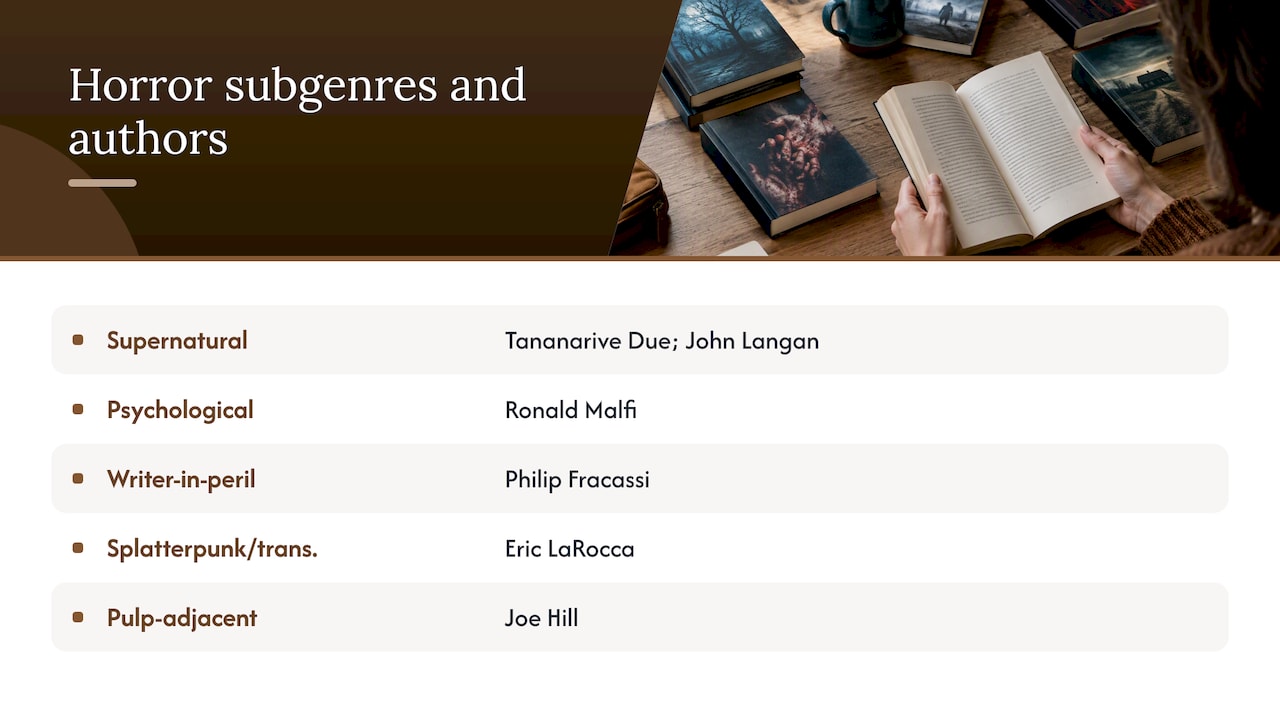
Supernatural horror, ghosts, curses, and ancient evils, is where Tananarive Due and John Langan do their best work, both using folklore and history to make the supernatural feel earned rather than arbitrary. Psychological horror, where the scares come from a character’s crumbling mind, is Ronald Malfi’s territory, with grief and obsession doing the heavy lifting instead of monsters.
The writer-in-peril subgenre, King’s own recurring specialty, belongs to Philip Fracassi, whose Gothic puts creative ambition and sanity on a collision course. Splatterpunk and transgressive horror, rawer and more visceral, is Eric LaRocca’s lane, useful for readers who want King’s grittier early instincts pushed further. And pulp-adjacent horror with a rock-and-roll edge is Joe Hill’s strength, blending supernatural objects with sharp, contemporary dialogue.
Knowing which lane you prefer makes browsing faster and cuts down on mismatched purchases, which is exactly what preview chapters are built to prevent.
7. Exploring Crossover Authors for Blended Genres
If you like King’s horror but also want crime plotting or fantasy scope, a few crossover paths are worth exploring. Horror blended with crime fiction tends to favor tight pacing and a detective or investigator figure dropped into supernatural territory, a structure that rewards readers who want mystery mechanics alongside dread. Horror blended with fantasy, meanwhile, leans into mythology and world-building, closer to King’s Dark Tower side than his small-town horror side.
Readers who want that blend should look for books marketed as “dark fantasy” or “supernatural thriller” rather than straight horror, since those labels usually signal more plot scaffolding and less pure atmosphere. Our thriller versus horror breakdown walks through exactly this kind of genre-blend decision in more detail, useful if you’re not sure which shelf your next read should come from. The short version: if you want answers and resolution, lean thriller-horror blends; if you want mood and myth, lean horror-fantasy blends.
8. What This List Gets Right That Most Don’t
Most “authors like Stephen King” lists are really just horror authors with no explanation of why they match. That’s the gap worth naming: a recommendation only helps if it tells you which part of King you’re actually chasing, the slow-burn dread of It, the claustrophobic terror of Misery, or the pulpy violence of his early paperbacks.
The conventional advice treats King as one flavor, when he’s really four or five distinct writers across his career. A reader who loved The Shining and a reader who loved Christine want different things, even though both are “Stephen King books.” Matching substyle to substyle, the way this list does, is more useful than matching genre label to genre label.
What I’d prioritize first: read the opening pages before anything else. Voice tells you more in two paragraphs than a blurb tells you in two hundred words, and it’s the single best predictor of whether a book will actually scratch the itch a King novel left behind.
— lorraine
Try Preview Chapters First on Our Shelves
We built our catalog around the exact problem this list solves: knowing an author’s style before you spend money on the wrong book. Two titles worth sampling directly are ELVIS DIED I WAS THERE, an original thriller with a preview chapter available, and Martha’s Tide, a character-driven horror title with the same atmospheric, small-town dread that draws readers to King in the first place.
- Both titles let you read a free opening chapter before buying, so you can check voice and pacing the same way we recommend doing with any new author.
- The sample-then-decide flow is simple: open the preview, read a few pages, and buy only if the narrator’s voice matches what you’re after.
- Browse our full horror collection or thriller collection to find more titles with the same preview option.
If you want a quicker taste of creature-driven horror specifically, our partner roundup of curated creature feature ebooks with previews is a good next stop. Start with either featured title above, or head to our full e-book catalog to browse everything we carry.
FAQ
What book does Stephen King regret writing?
King has spoken publicly about mixed feelings toward certain early or rushed works over the years, though no single title is universally cited as his definitive regret. Readers curious about his full catalog can review his major works, including Carrie, The Shining, It, and Misery, through his Britannica biography.
What author was rejected 23 times?
This often-cited detail is frequently attributed to Stephen King regarding early submissions of his work, though exact rejection counts vary across retellings and aren’t confirmed in primary biographical sources. What’s well documented is that he built a prolific career afterward, selling more than 400 million books worldwide.
Is Stephen King one of the greatest writers?
Critics often place King among the most significant popular writers of his generation, with some comparing his broad cultural reach and narrative craft to Charles Dickens. His ability to bridge mass appeal and literary technique is a major reason so many readers look for authors who write similarly.
Who are some famous horror book authors?
Beyond Stephen King, well-known horror authors include Tananarive Due, John Langan, Ronald Malfi, Philip Fracassi, and Joe Hill, each known for a different substyle within the genre. Readers can explore starter titles from each through our curated recommendations above.
How can I sample an author before buying their book?
Many digital bookstores, including ours, offer preview chapters that let you read the opening pages of a title before purchase. This approach helps you judge narrator voice and pacing in advance, which is especially useful when trying a horror author for the first time.
Sources
- Stephen King | Biography, Books, Movies, TV Shows, & Facts | Britannica
- Stephen King is our Dickens – New Statesman
- Interview With Eric LaRocca, Author Of ‘Burnt Sparrow – We Are Always Tender With Our Dead’ – PopHorror
Recommended
- 8 Authors Like Gillian Flynn: Each With a Starter Book and Preview – Thriller Suspense
- Match Your Mood: Short Horror Story Collections You Can Preview First – Thriller Suspense
- Preview First: 4 Survival Horror Books From Prepper to Literary – Thriller Suspense