Weird fiction ebooks are the easiest way to try a genre that is hard to describe and easy to bounce off. Start with an anthology or a short novel. Read a sample first. Go in expecting dread and atmosphere, not a tidy explanation. This guide covers what the genre is, the books worth your time, and how to avoid paying for a book that is not what you wanted.
TL;DR
- Weird fiction trades ghosts and vampires for the uncanny: forces too large or strange to explain. It rarely ends with the mystery solved.
- Good first reads: Lovecraft’s collected tales, the huge anthology The Weird, and China Miéville’s Perdido Street Station if you want a novel.
- Many early classics are free and legal to read, so pay for newer work, curated collections and exclusives.
- Always read a sample chapter before you buy. Tone is the thing that decides whether weird fiction works for you.
- Browse our Horror and Thriller collections and preview chapters first.
Table of Contents
- What weird fiction actually is
- Old weird, new weird
- Where to start: five reliable entry points
- How to read it without getting frustrated
- Free classics versus paid ebooks
- Our perspective
- Related reading from our blog
- Preview before you buy
- A simple plan for your first month
- Common mistakes to avoid
- FAQ
- Sources
What weird fiction actually is
Weird fiction is a subgenre of speculative fiction that began in the late 19th and early 20th centuries. According to Wikipedia’s overview of the genre, it either avoids or radically reinterprets the usual antagonists of supernatural horror, such as ghosts, vampires and werewolves. What replaces them is stranger: something incomprehensible, often cosmic in scale, that the characters cannot fight or fully understand.
That is why the tentacle became the genre’s shorthand. It stands for a thing that does not fit our categories. The fear comes from scale and ambiguity, not from a jump scare.
Compare it with the neighbors on your shelf:
| Genre | What scares you | How it usually ends |
|---|---|---|
| Traditional horror | A monster, ghost or killer | The threat is confronted, often defeated |
| Thriller and suspense | A person or plot with a ticking clock | The puzzle is solved, the culprit exposed |
| Weird fiction | Something beyond explanation | The strangeness stays strange |
If you read thrillers and horror already, you have most of the skills you need. You just have to drop one expectation: that the book owes you an answer.
Old weird, new weird
Two labels come up constantly, and it helps to know the difference.
The classic era runs from the late 1800s through the pulp magazines of the 1920s and 30s. Lovecraft is the name most people know, but the period also produced a wide range of writers who built atmosphere out of landscape, dreams and the sense that the universe does not care about us.
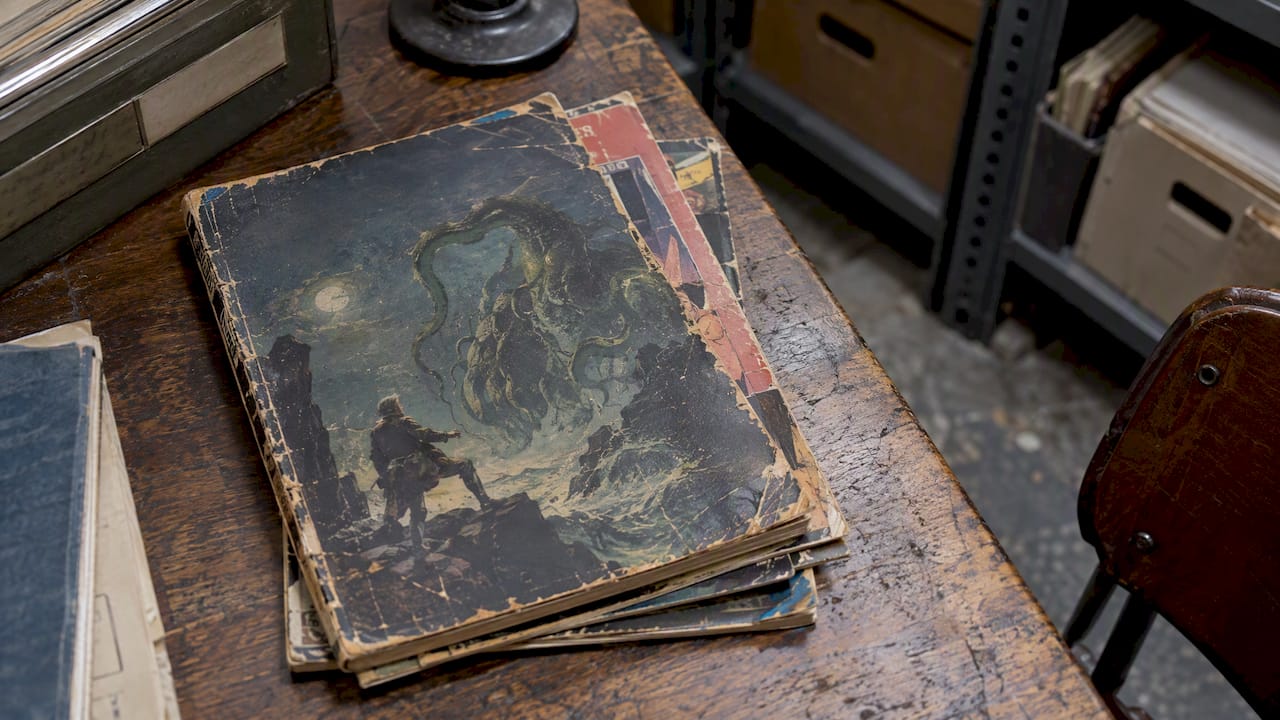
The New Weird is a more specific movement. Skriuwer’s guide to new weird fiction describes it as a literary subgenre that blends secondary-world fantasy, science fiction and horror, then refuses to resolve the strangeness into a tidy explanation. It grew up in the early 2000s as a reaction to both high-fantasy clichés (elves and wizards) and the comfort of horror in which a monster gets explained and dealt with. Jeff and Ann VanderMeer’s notes on The New Weird anthology are a good primary source if you want to see how the people involved talk about it.
In practice: old weird tends to be short, eerie and cosmic. New weird tends to be longer, more political and more textured, with cities and creatures that feel invented from scratch.
Where to start: five reliable entry points
You do not need to read in chronological order. Pick the door that matches how you already read.
If you like short, sharp stories: Lovecraft
Collider’s ranking of the greatest weird fiction books puts H.P. Lovecraft’s The Dunwich Horror and Others among the essentials for foundational cosmic horror. Several of his stories are also easy to find for free. The Shadow Over Innsmouth, written in 1931 and published as a book in 1936, is available as a free download. It is a fair test: if Innsmouth does not grab you, the classic strain probably is not for you.
If you want the whole map: The Weird
Jeff and Ann VanderMeer’s anthology The Weird collects 110 stories by writers ranging from literary legends to Booker Prize winners, roughly 750,000 words in all. Jeff VanderMeer announced the e-book edition for North American readers in 2012. For a newcomer, it is the best value in the genre. One file lets you test dozens of voices instead of buying a dozen separate books to find out which style suits you.
A tip for reading it on an e-reader: do not go front to back. Dip in, read a story, close it. The anthology is built for sampling.
If you want a novel with momentum: Miéville
China Miéville’s Perdido Street Station, published in 2000, is often named as the book that carried the New Weird toward a wider audience. It is dense, inventive and plot-driven, which makes it a comfortable first long read for thriller fans who want a story to follow while the strangeness piles up.
If you want to see what is new right now
The genre is active. As of this month, Speculativentory’s new releases list shows titles such as Caitlin Starling’s Milkteeth arriving on October 20. Grace Krilanovich’s Acid Green Velvet came out from Seven Stories Press on 6 October 2026, according to its Penguin Books listing, as a 280-page novel. Release formats and prices differ by retailer and country, so check the ebook edition and price where you shop.
If you want a guided tour of the movement
David Somerfleck’s definitive guide to the New Weird frames the tradition as literature of the discomfiting rather than the consoling. It is a helpful read before you pick your second and third books.
How to read it without getting frustrated
The most common complaint from new readers is not that the books are bad. It is that they feel unfinished. Genre experts quoted by Skriuwer point out that weird fiction does not give you the catharsis of a monster being killed or a mystery being solved. The point is a lingering sense of uncertainty.
That is a design choice, not a plot hole. A few habits make it easier:
- Do not treat it as a puzzle. If you keep hunting for the hidden logic, you will miss what the author is building: mood, awe, wrongness.
- Read the first chapter for voice. Weird fiction lives or dies on prose. Within ten pages you will know whether the narrator’s tone is for you.
- Let a story sit. The best endings work after you close the book.
- Mix lengths. Alternate a short story with a novel so one slow book does not sour the genre.
- Keep a thriller handy. There is no shame in a palate cleanser with a satisfying ending.
Free classics versus paid ebooks
This is where many readers spend money they do not need to. A lot of foundational weird fiction is old enough to be in the public domain in the US, which means legal free copies exist. Lovecraft’s 1930s work is a good example, as the free Innsmouth edition above shows. Check the status of any specific title before assuming, since copyright depends on publication date and renewal.
So where does paying make sense?
- Recent novels and collections. Living authors are still working, and buying their ebooks is how they keep writing.
- Curated editions. A well-chosen collection saves you the hours of hunting through archives.
- Exclusive and original titles. Work you cannot find in the free archives or on the big shelves.
- Better formatting. Free scans can be messy on an e-reader. Clean files are worth a small price to many people.
A sensible budget approach: read the public domain classics to learn what you like, then spend on newer authors who write in that vein.
Our perspective
We run a small store built around digital horror, thriller and suspense, and weird fiction sits right on the border of all three. Here is how we think about it.
The biggest risk in buying any dark fiction is tone. A book described as eerie can turn out gory. A book sold as a thriller can turn out slow and ambiguous. With weird fiction the mismatch is sharper, because the genre deliberately withholds the payoff many readers expect. That is why we put previews at the center of what we do. Reading a chapter first costs you five minutes and saves you from a purchase that was never going to work.
We also keep the catalog narrow on purpose. We sell only digital titles in thriller, horror and suspense, so browsing is about moods and genres, not wading through everything. If you are coming from thrillers, our Thriller collection is a natural base. If you want the dread without the tidy ending, start in Horror and read the sample before you commit.
Our advice for a first-time weird reader: choose one short work and one longer work, sample both, and buy the one whose opening voice you could happily hear for another hundred pages.
— lorraine
Related reading from our blog
Weird fiction overlaps with several other kinds of dark fiction, and our guides can help you steer between them.
- If the cosmic angle is what hooks you, our guide to picking cosmic horror in five minutes covers formats and previews for new readers.
- If you prefer variety, short horror story collections are matched to mood and can be previewed first. They are the closest cousin to the anthology approach.
- If monsters are your thing, our creature feature ebook picks offer six or seven tales to sample.
- If the body is where your fear lives, try our body horror reading list.
Each of these works the same way: sample first, then decide.
Preview before you buy
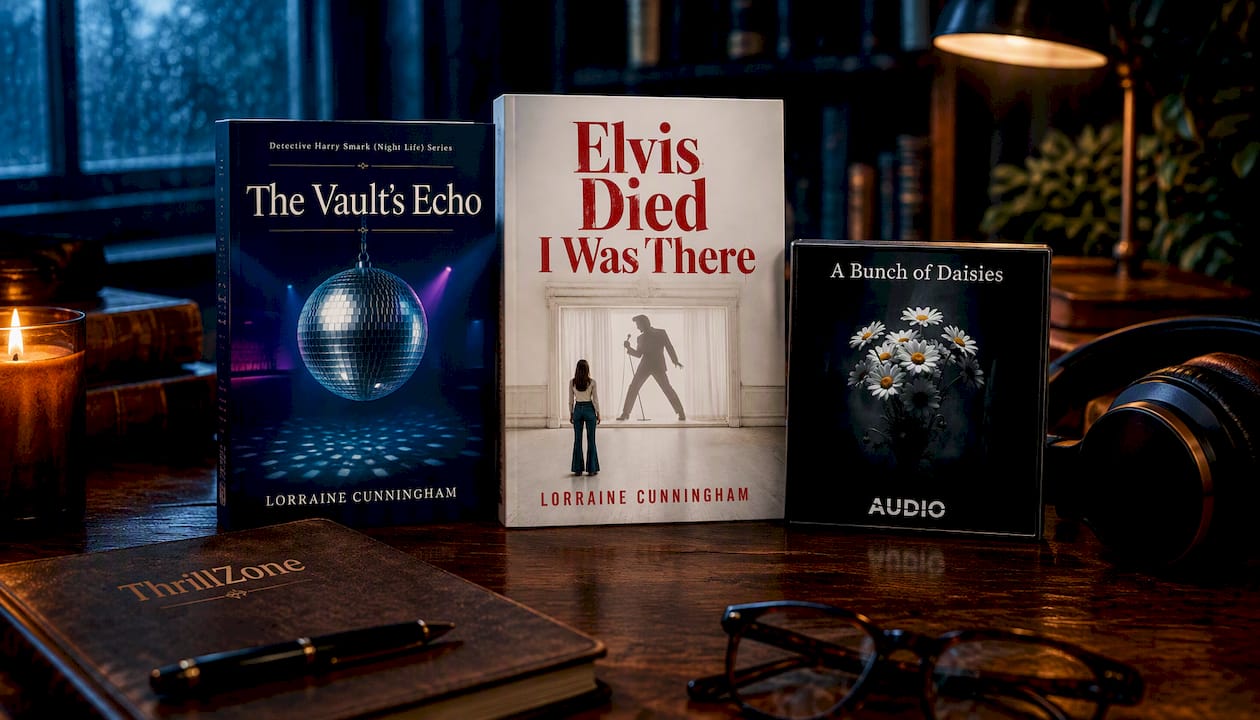
If you want to try dark fiction without gambling on a full price, browse our digital e-book storefront. Titles come with exclusive preview chapters, so you can judge the voice and tone before you check out. Among our originals is Elvis Died I Was There, a thriller you can sample first. Readers who like series can also look at Detective Harry Smark (The Vault’s Echo, Book 2).
We do not publish a weird fiction category as such, so use the Horror and Thriller collections as your starting points and let the previews guide you.
A simple plan for your first month
If you want a structure, here is one that works for most readers.
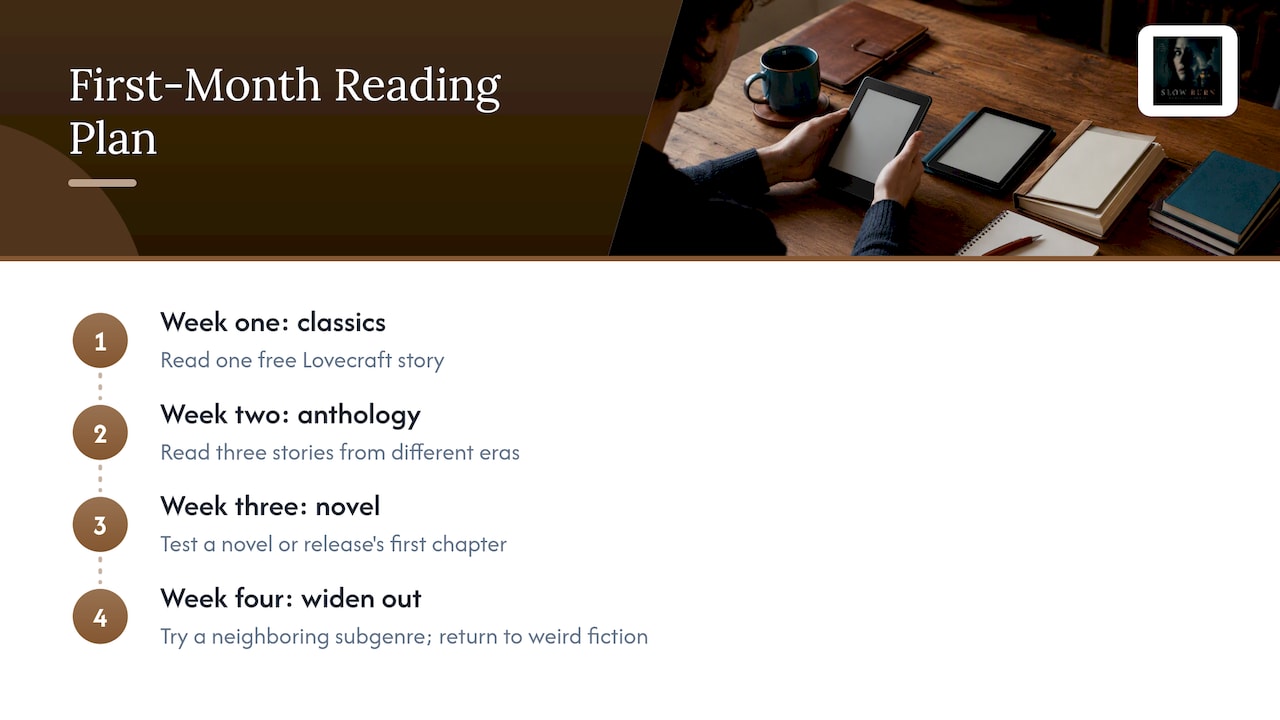
Week one: test the classics for free. Read one Lovecraft story from a free public domain source. Note whether you enjoyed the atmosphere or just the idea of it.
Week two: sample the anthology. Open The Weird and read three stories from different eras. Mark the ones you liked and look up the authors.
Week three: try a novel. Sample Perdido Street Station or a recent release. If the first chapter hooks you, buy it. If it does not, move on without guilt.
Week four: widen out. Try a neighboring subgenre such as cosmic horror, folk horror or creature features, using previews to check tone. Then return to weird fiction with a clearer sense of what you want.
By the end of the month you will know whether you want more of the ambiguity, more of the atmosphere, or something with a firmer ending. All three answers are fine.
Common mistakes to avoid
- Buying a long novel blind. One bad fit costs you a week of reading time as well as money.
- Expecting answers. Weird fiction rewards patience, not decoding.
- Paying for what is free. Check whether a classic is in the public domain before buying.
- Skipping the sample. Prose style is the whole game here.
- Reading everything in one genre. The strongest weird readers also read thrillers and horror, and the contrast sharpens both.
FAQ
What is the difference between weird fiction and horror?
Horror usually centers on a threat you can name, such as a ghost, a killer or a monster, and often lets the characters confront it. Weird fiction centers on something that resists explanation, and it tends to leave the strangeness unresolved. Many books sit in both camps, which is why horror readers often make good weird fiction readers.
What is the best weird fiction book for a beginner?
For short stories, start with Lovecraft or sample The Weird anthology, which gives you 110 stories in one ebook. For a novel, China Miéville’s Perdido Street Station is a common first pick. Read the opening chapter first, since voice matters more than reputation.
Are there good new weird novels coming out now?
Yes. Recent and upcoming releases include Grace Krilanovich’s Acid Green Velvet and Caitlin Starling’s Milkteeth, which are listed on trackers of new speculative releases. Check the ebook edition and price with the retailer you use, since they vary.
Can I read weird fiction ebooks for free?
Some of it, yes. Many early classics are old enough to be in the US public domain and are offered as free downloads from archive sites. Newer novels and collections are still under copyright, so you will usually pay for those.
Sources
- Weird fiction, Wikipedia
- The 10 Greatest Weird Fiction Books, Ranked, Collider
- Best New Weird Fiction Books in 2026, Skriuwer
- The New Weird Anthology: Notes and Introduction, Jeff VanderMeer
- The Weird Antho: 750,000 Words of Fiction, Jeff VanderMeer
- The Shadow Over Innsmouth, free download
- Welcome to the Borderlands: A Definitive Guide to the New Weird
- New releases, Speculativentory
- Acid Green Velvet, Penguin Books Australia
Recommended
- Japanese Horror Novels: Where to Start, What to Read Next
- Splatterpunk eBooks: Look Beyond Big Stores, Sample a Chapter
- Sample 6–7 Tales: Curated Creature Feature Ebooks with Previews
- 12 Black Horror Authors to Read First, With Preview Chapters