A cat and mouse thriller is a novel built around a pursuit: one character hunts, chases or psychologically toys with another, and the pressure climbs as the hunted tries to evade, outwit or even reverse the roles. The best ones are duels between two sharp minds, so you keep turning pages to see who blinks first. Below you will find what defines the genre, books worth starting with, and a practical way to test one before you buy.
TL;DR
- A cat and mouse thriller is a suspense structure where hunter and hunted keep trading advantages, and the tension comes from who knows what.
- The strongest examples give both sides real skill and real motives, so neither is a cardboard villain or a helpless victim.
- Good starting points range from serial killer hunts like Rules of Prey to puzzle-box mysteries and horror hybrids with vampires or supernatural killers.
- Before buying, read a preview chapter and check three things: incompatible goals, layered motives and escalating obsession.
- These books suit book clubs because the characters’ choices and methods are easy to argue about.
Table of Contents
- What makes a book a cat and mouse thriller
- The main flavors of the genre
- A quick comparison
- How to judge a cat and mouse thriller from a preview
- Why these books work so well for book clubs
- Series to read in order
- Try a chapter, then keep the one that hooks you
- FAQ
- Sources
What makes a book a cat and mouse thriller
The label gets used loosely, so it helps to be precise. In a cat and mouse story, the plot is the contest itself. A detective closes in on a killer, a fugitive stays one step ahead of the law, or two rivals run schemes against each other. Each move forces a countermove. The reader is not waiting for a twist to be dropped from above; they are watching two people adapt.
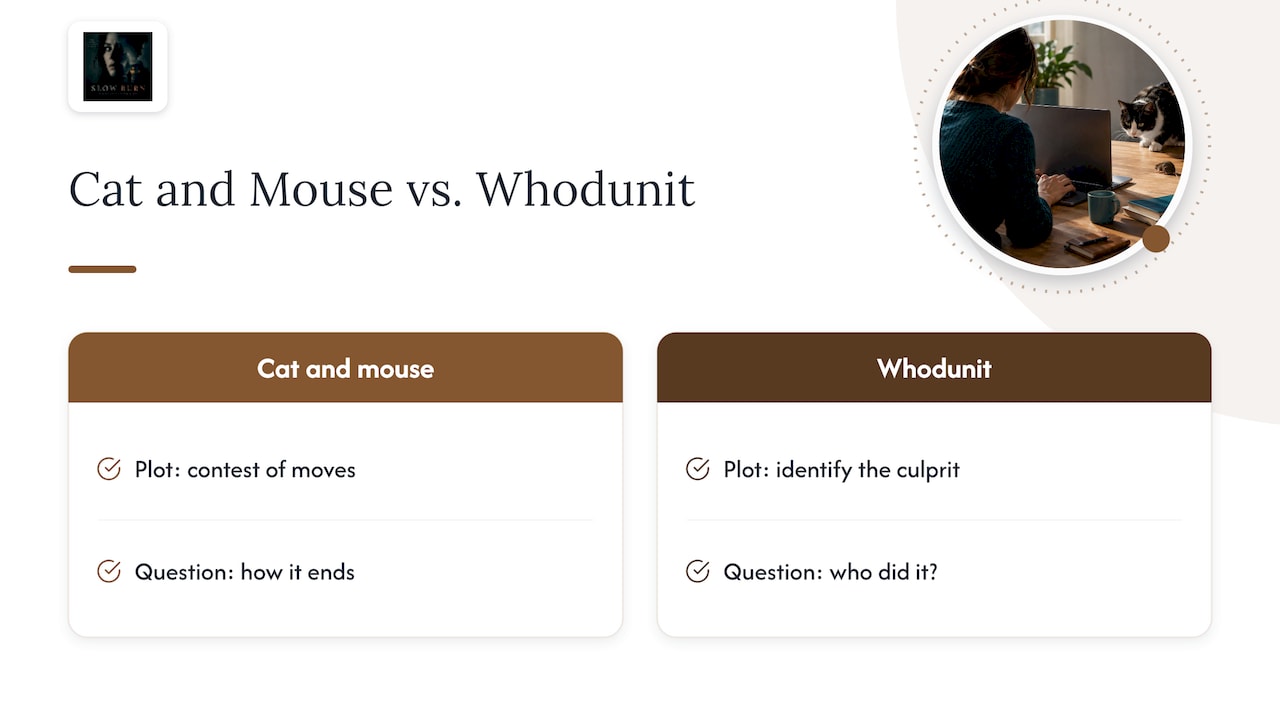
That is different from a whodunit, where the question is who did it. In a cat and mouse book you often know, or soon learn, who the hunter and the hunted are. The question becomes how it ends, and whether the roles flip on the way there. Writer’s Digest draws a useful line between genres: thrillers focus on fear, doubt and dread, with a vulnerable hero, villains who aim at specific weaknesses and wants, and ultimate stakes. Cat and mouse is the thriller’s most concentrated form of that idea.
Two antagonists, not one villain
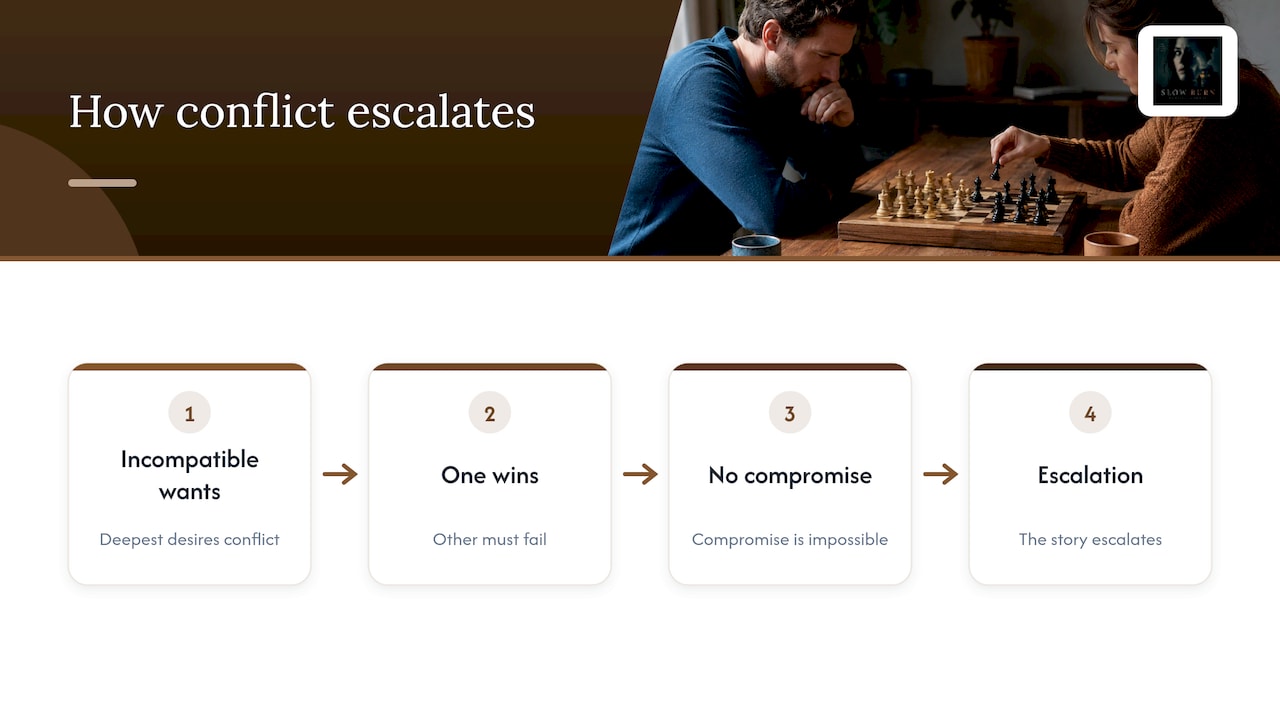
Writer’s Digest notes that well-executed examples often feature two protagonists who discover they are antagonists: their deepest desires are incompatible, so one can only win if the other fails. That single idea explains why the genre grips. If both characters want something badly, and what one wants destroys the other’s chance, compromise is impossible and the story has to escalate.
The same piece says satisfying stories give both antagonists layered motivations, properly motivated even when they are deluded about why they act. In practice, this is the difference between a killer who is simply evil and one whose logic you can follow, even as it horrifies you.
Competence on both sides
Craft guidance from Pendraic Help makes a point readers feel instinctively: these stories demand competent protagonists on both sides, and the pleasure lies in watching them outmaneuver each other in a duel of wit, competence and will. If the hunter is clumsy, there is no threat. If the quarry is helpless, there is no game.
Information is the weapon
Most cat and mouse plots run on an imbalance of knowledge. One side holds evidence or a secret the other lacks, and the story becomes a sequence of strategic adjustments: surveillance, a deliberately timed reveal, a staged alibi. Pendraic Help adds a warning for writers that readers will recognize as a reader’s complaint too: to avoid repetitive tit-for-tat, the dual points of view need discipline, because an unfair perspective advantage can make the game feel rigged.
So when you pick up one of these books, ask whether the author plays fair. Do you learn things at a rate that keeps both sides plausible? Or does the narrative cheat to keep one character ahead?
The main flavors of the genre
Cat and mouse is a structure, not a subgenre, so it shows up everywhere. Here are the forms you will meet most often.
Detective versus serial killer
The classic. A investigator pursues a killer who is clever enough to pursue back. Kirkus Reviews called John Sandford’s Rules of Prey (1989) a first-rate cat-and-mouse thriller about cop Lucas Davenport trying to catch the serial killer Louis Vullion. It is a good model of the form: the reader meets both men, and the contest feels personal.
If this is your lane, we collected related reading in our guides to serial killer thrillers with detectives and a longer starting list of serial killer thrillers and series. For the investigative side, our piece on why forensic thrillers feel so dangerous explains how procedure itself becomes a source of dread.
Puzzle-box and intellectual games
Sometimes the contest is against a structure rather than a single person. BookPage described Stuart Turton’s The 7½ Deaths of Evelyn Hardcastle as an intellectual thriller and a dizzying game of cat and mouse, in which the protagonist must inhabit different guests’ bodies to solve a murder. It shows how far the idea stretches: the hunter, the hunted and the puzzle can all blur together.
Horror hybrids
Add the supernatural and the chase gets stranger. Publishers Weekly described Randy Ribay’s Nest of Tongues as a paranormal cat-and-mouse thriller in which Filipino vampire siblings must evade a legendary monster hunter. Here the roles are deliciously unstable, since the hunted are themselves predators.
Kim Bohyun’s Mothersucker goes darker and more political. BookPage reviewed it as a fusion of supernatural horror with the reality of gender-based violence, following a detective who hunts a serial killer targeting men who have committed crimes against women. The reviewer, Jessica Peng, observed that horror-thrillers like this use supernatural themes to explore all-too-real horrors and push readers to question their own ideas of justice. That is cat and mouse doing more than entertaining: the reader’s sympathies become part of the chase.
For more along these lines, browse our guides to supernatural thrillers and psychological horror books by mood.
Survival chases
When the cat is a person and the mouse is stranded somewhere hostile, or when nature itself closes the net, you get the survival variant. Our roundup of survival thrillers where nature and fear close in covers books that borrow the same escalating pursuit with the landscape as an accomplice.
A quick comparison
| Flavor | Who hunts whom | What drives the tension | Good if you like |
|---|---|---|---|
| Detective vs. killer | Investigator and a clever offender | Personal stakes, evidence, near misses | Procedurals, character duels |
| Puzzle-box | Protagonist vs. a structure or hidden adversary | Rules, loops, reveals | Clever plotting, rereading |
| Horror hybrid | Monsters, hunters, or avengers | Shifting roles, dread, moral unease | Dark atmosphere, gray morality |
| Survival | Person vs. person or environment | Scarcity, isolation, time pressure | Fast pacing, physical stakes |
How to judge a cat and mouse thriller from a preview
Because the genre depends on the quality of the duel, a first chapter tells you a lot. You do not need to finish the book to know whether the game will work. Use the three tests from the craft guidance above as a checklist.
- Are the desires incompatible? By the end of the sample, can you state what each side wants, and see that both cannot have it? If the goals could coexist, the pursuit will feel arbitrary.
- Are the motives layered? Look for a reason behind the reason. A hunter who just wants justice is thin; one who wants justice and is haunted by an old failure has something to lose. The same goes for the quarry.
- Does obsession drive the behavior? Escalation is the engine. If characters start taking risks they would not normally take, the story has somewhere to go.
Then add a few taste questions. Reading advice from The Index suggests asking whether tension comes from character or plot, how fast the story moves, how much ambiguity you can tolerate and what setting you favor. Pacing matters especially. Some celebrated thrillers start slowly and build to a fast climax, and some listings also flag content like graphic violence, murder, psychological manipulation and abuse. A preview is the cheapest way to find out whether a book’s tone and intensity match what you want tonight.
Two more things to notice in a sample:
- Information flow. Do you know slightly more than the hunter, slightly less, or the same? Any of these can work, but it should feel deliberate.
- Voice of the quarry. In the best books, the mouse is not passive. If the hunted character is already making clever choices in chapter one, the reversal later will feel earned.
Why these books work so well for book clubs
Cat and mouse stories give a group something concrete to argue about. Motives and methods are contestable: was the detective justified in crossing a line, was the killer’s logic coherent, did the author play fair with information? Stacey Carroll argues that the genre hooks readers by turning suspense into a mental game and by creating an emotional hook through a clever underdog. That underdog is where discussion usually starts: who did you root for, and when did that change?
Some prompts that work for almost any title:
- At what moment did the balance of power shift, and who noticed first?
- Which character had better information, and how did they use it?
- Did you ever side with the antagonist? What did the author do to make that possible?
- Would the ending land the same way if the roles had never reversed?
If your group likes darker material, a horror hybrid is a strong pick, because the supernatural frame gives people distance to discuss uncomfortable themes. If your group prefers realism, start with a detective duel.
Series to read in order
Some cat and mouse books sit inside longer series, and order can matter for character arcs. Meg Gardiner’s UNSUB books follow FBI profiler Caitlin Hendrix, and Into the Black Nowhere is the second in that series, so starting at the first spares you from spoilers about the recurring cast. The same logic applies to any title labeled with a book number: check the numbering on the page before you buy, and read from book one if the characters carry grudges or injuries forward.
Our perspective
We built this store around one frustration: paying for a thriller and discovering by chapter three that the game you were promised is not the one on the page. Cat and mouse is the genre where that mismatch hurts most, because the whole pleasure rests on a duel that either works or does not.
That is why we focus only on digital thriller, horror and suspense titles, and why we let readers sample chapters before they commit. A preview is not a gimmick for us. It is how you find out whether the hunter and the hunted are both worth following, and it is how you discover authors you would never have risked a purchase on blind.
Our advice is simple. Read the opening, ask who wants what, and notice whether both sides are given brains. If they are, you are probably in good hands. We would rather you buy one book you love than three you abandon.
lorraine
Try a chapter, then keep the one that hooks you
If you want a pursuit story you can test before paying, start with our thriller collection and open the preview chapters. For something with more dread, the horror collection carries the darker end of the same instinct.

If you like series, look at Detective Harry Smark (The Vault’s Echo Book 2) and The Whispering Veil Of Oakhaven (Series Book 2), and check the series numbering on each page. You can also browse everything on the store’s main page.
FAQ
What is the best cat and mouse thriller?
There is no single best, because it depends on the flavor you like. For a classic detective against serial killer duel, Rules of Prey is a strong place to begin. For something more cerebral, try The 7½ Deaths of Evelyn Hardcastle. For horror, Nest of Tongues reverses the usual predator and prey roles.
How is a cat and mouse thriller different from a mystery?
A mystery centers on discovering who committed a crime. A cat and mouse thriller centers on the ongoing contest between two opponents, and the reader often knows who they are early. The suspense comes from each side’s strategy and from who holds which information at any moment.
Can a cat and mouse story be horror?
Yes. Horror hybrids keep the pursuit structure but add supernatural or monstrous elements, as in books about vampires evading a hunter or a detective chasing a killer with uncanny qualities. The fear comes from both the chase and the unsettling nature of the pursuer or the pursued.
What should I look for in a preview chapter?
Check whether the two sides want incompatible things, whether their motives have more than one layer, and whether obsession is already pushing them to take bigger risks. Also judge the pacing and tone, so you know the intensity suits you before you buy.
Are cat and mouse thrillers good for book clubs?
They are among the easiest to discuss. Characters’ methods and motives are debatable, the balance of power shifts, and readers often disagree about whom they sympathized with. A short list of prompts about information, reversals and fairness usually fills an evening.
Sources
- How to Write a Gripping Cat and Mouse Thriller, Writer’s Digest
- The Differences Between a Crime, Mystery, and Thriller Novel, Writer’s Digest
- Cat-and-Mouse Thriller, Pendraic Help
- Rules of Prey, Kirkus Reviews
- The 7½ Deaths of Evelyn Hardcastle, BookPage
- Nest of Tongues by Randy Ribay, Publishers Weekly
- Mothersucker by Kim Bohyun, BookPage
- What Is a Cat and Mouse Thriller, Stacey Carroll
Recommended
- Supernatural Thrillers: What They Are and Which to Read
- Short Thriller Books: Fast, Tense Reads to Finish in a Sitting
- Survival Thrillers: Books Where Nature and Fear Close In
- How to Pick Ebook Thrillers That Keep You Awake