If you want Japanese horror novels in English, start with Koji Suzuki’s Ring for the genre’s modern origin, Natsuo Kirino’s Out for crime-tinged dread, Otsuichi’s Goth for something cold and elegant, and Junji Ito’s Uzumaki if you’ll take manga. Most of the dread in these books comes from atmosphere and slow pressure rather than gore. This guide explains why that is, ranks the best entry points by the kind of fear you want, and shows how to pick a translation you’ll actually finish.
TL;DR
- Japanese horror (J-horror) favors psychological, atmospheric dread over jump scares and slashers. Expect slow builds and endings that linger.
- Best first reads: Ring (Koji Suzuki), Out (Natsuo Kirino), Goth (Otsuichi), Another (Yukito Ayatsuji), and Uzumaki (Junji Ito).
- Short stories are an easy way in. Ugetsu Monogatari (1776) and Lafcadio Hearn’s Kwaidan show where the tradition began.
- Translation quality changes how frightening a book feels. Read a sample page before you buy.
- Preview before you commit. It is the cheapest way to learn whether a book’s pace suits you.
Table of Contents
- What makes Japanese horror different
- Seven Japanese horror novels worth your time
- Match the book to the kind of fear you like
- Why the translation matters
- How to read J-horror without getting frustrated
- Our view: what we look for in a horror read
- Where to go next if you like slow, atmospheric dread
- Preview a horror read before you buy
- Frequently asked questions
- Sources
What makes Japanese horror different
Japanese horror is horror fiction drawn from Japanese popular culture, and it is generally noted for treating the genre differently from Western tradition. The main difference is where the fear sits. A Western slasher puts it in the threat: the killer, the knife, the chase. J-horror puts it in the situation: a house, a family, a rule you broke without knowing.
Three features come up again and again.
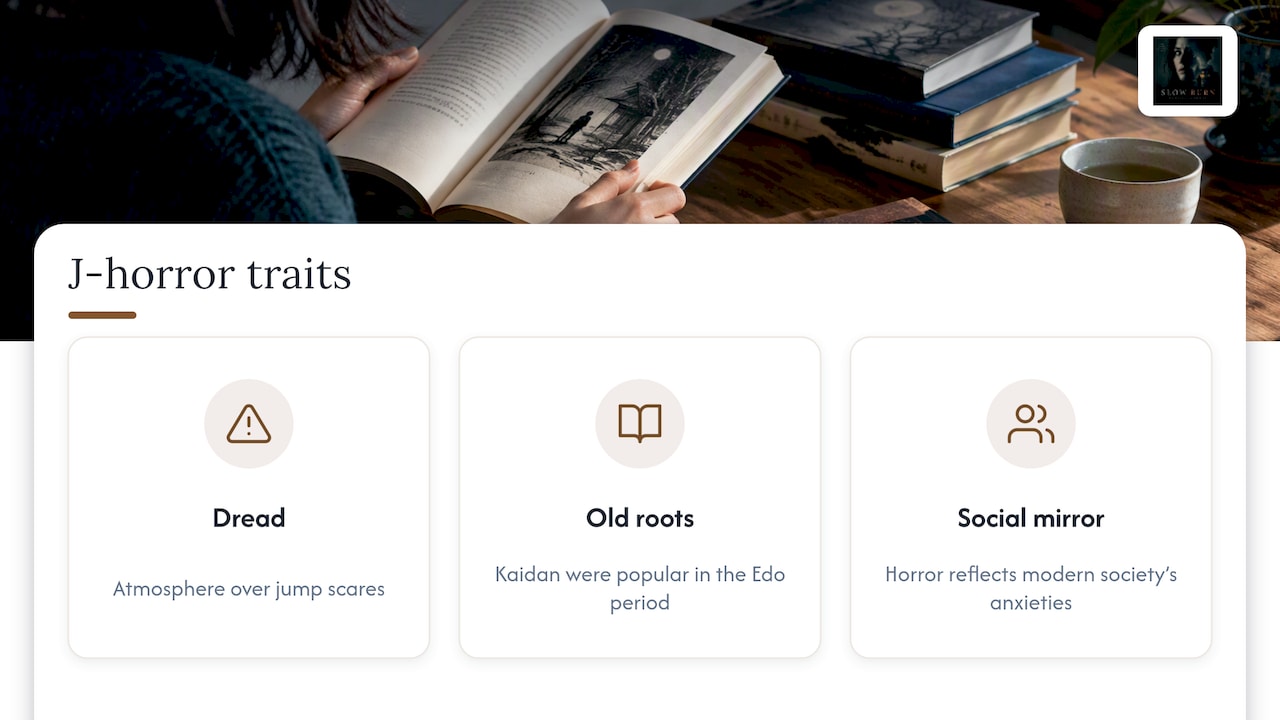
Dread over shock. Media researchers have argued that the genre’s pivot to psychological storytelling, away from jump scares and toward dread, is a big reason it traveled worldwide in the 1990s and 2000s. If you like atmosphere more than splatter, this is your corner of the genre.
Old roots. The modern books descend from kaidan, strange tales of ghosts and the supernatural that were hugely popular in the Edo period. One tradition behind them is the hyakumonogatari kaidankai, a gathering where people told 100 ghost stories in the dark. That scholarly history of kaidan traces how the form moved from parlor game to modern pop culture. The long-haired woman in white is a famous example of a motif that reaches back to Noh and Kabuki theater, and it shows up in Suzuki’s Ring.
A mirror, not just a monster. Suzuki has said his horror is about the anxieties of modern society. In a New York Times profile, the same piece that calls him the “Stephen King of Japan,” his books are framed as holding up a mirror to the cruelty and corruption of everyday life rather than simply haunting a house. That is why the fear sticks. When the ghost is a symptom of something real, you can’t close the book and leave it behind.
Expect slower pacing than you may be used to. The first fifty pages often feel quiet. That is not a flaw, it is the setup.
Seven Japanese horror novels worth your time
These are chosen for range. Ratings are from Goodreads lists and shift over time, so treat them as a snapshot, not a verdict.
Ring by Koji Suzuki (1991)
The novel behind the famous films is a different animal: a journalist investigating a string of deaths linked to a cursed videotape. It reads more like a medical-detective thriller than a ghost story, which surprises people who only know the movies. Suzuki has sold more than 10 million copies of his horror in Japan. On Goodreads’ J-Horror in translation list, Ring sits near the top with a 3.77 average from more than 33,000 ratings.
Read it if: you want the origin point and don’t mind a clinical, investigative tone.
Out by Natsuo Kirino (1997)
Four women working a night shift at a boxed-lunch factory cover up a killing. It is crime fiction more than horror in the strict sense, but the dread of domestic entrapment is relentless. The same list shows Out at a 3.93 average across about 50,000 ratings. It sits where thriller and horror overlap, which is exactly where many readers of both genres want to be.
Read it if: you like gritty, character-driven suspense and don’t need anything supernatural.
In the Miso Soup by Ryu Murakami (1997)
A young guide who shows foreign tourists around Tokyo’s nightlife spends three nights with a client he slowly realizes is dangerous. It is harrowing, short, and built on an escalating sense that something is off. Readers shelve it under Japanese horror on Goodreads’ japanese-horror shelf.
Read it if: you want a tight, uncomfortable read in one or two sittings.
Goth by Otsuichi
Two high school students share an interest in murder and the macabre. The book is a linked set of stories, cool in tone and unsettling because nobody in it panics. It scores around 3.97 on the Japanese horror fiction list, with several thousand ratings.
Read it if: you like your horror elegant, morally murky, and told in short pieces.
Another by Yukito Ayatsuji
A transfer student arrives at a school class that seems to be hiding a rule about one of its pupils, and deaths follow. It blends a whodunit structure with a curse. It averages about 4.14 on the J-horror translation list, though from far fewer ratings than the big names.
Read it if: you enjoy puzzles and a school setting, and you want the mystery to matter as much as the fear.
Uzumaki by Junji Ito (1998)
A town becomes obsessed with spirals. It is a manga, not a prose novel, but no list of Japanese horror in English is complete without it. Goodreads’ Japanese horror fiction list puts the first volume at 4.44 across more than 45,000 ratings. Ito’s collections such as Shiver and Fragments of Horror are good for short, sharp doses.
Read it if: you want body horror and cosmic absurdity in a visual format.
Ugetsu Monogatari by Ueda Akinari (1776)
Nine tales of ghosts, vengeful spirits and broken promises. It is old, and some of the cultural references take effort, but you can see the DNA of later J-horror in it. Pair it with Lafcadio Hearn’s Kwaidan, which beginner guides to the genre also tend to mention as a foundational collection of strange tales.
Read it if: you care about where the genre came from, or you prefer short stories.
Match the book to the kind of fear you like
Not every Japanese horror novel will suit every horror reader. Use this to narrow it down.
| If you like… | Try | Why |
|---|---|---|
| Investigation and a ticking clock | Ring | Curse plot told like a case file |
| Crime with moral rot | Out | Domestic pressure leads to violence |
| Short, tense reads | In the Miso Soup | Compact and escalating |
| Quiet, chilly characters | Goth | Dread through calm narration |
| Mystery plus supernatural | Another | Rules, secrets, a curse |
| Visual body horror | Uzumaki | Obsession turned grotesque |
| Classic ghost stories | Ugetsu Monogatari | The tradition at its roots |
If you are new to the genre, begin with one novel and one short collection. Novels show you the slow burn; collections let you test several voices in a weekend.
Why the translation matters
Much of Japanese horror leans on small cues: how a family addresses each other, a word for a ghost that has no clean English match, a sentence that stops short. A weak translation flattens that. A good one keeps the unease.
The practical advice is simple. Check who translated the book, and prefer translators who have worked on Japanese genre fiction before. Then read the opening pages before you pay. If the prose feels stiff or over-explained in the first chapter, it will probably feel that way for 300 pages.
Publishers have learned this too. Editors quoted in a New York Times piece on Japanese fiction seeking U.S. fans described the titles that sell in English as the ones that blend traditional folklore with the modern urban experience and reach beyond purely Japanese cultural markers to universal fears. That fits the picks above: a cursed tape, a night-shift factory, a haunted classroom. Folklore is present, but the fear is one anyone can recognize.
How to read J-horror without getting frustrated
- Give it a hundred pages. The pacing is deliberate. If the dread is building, keep going.
- Don’t expect explanations. Many endings leave the rules of the haunting partly unexplained on purpose.
- Read at night, once, in long sittings. The genre grew out of ghost-story gatherings in the dark, so it works best when you let it accumulate.
- Mix in short fiction. If a novel stalls, a collection resets your appetite.
- Follow the adjacent tradition. If you like what you find, folk horror and psychological horror from other countries share a lot of ground, which we cover below.
Our view: what we look for in a horror read
We run a store focused only on digital thriller, horror and suspense, so we spend our days thinking about one question: how does a reader know a book is right for them before they pay?
Japanese horror makes that question sharper than most genres. The pacing is unfamiliar to many American readers, and the value of a book depends on whether its voice grabs you in the first chapter. That is why we believe in previews. A sample tells you more than a cover, a blurb or a star rating. It shows you the rhythm of the prose, and in a genre built on rhythm and restraint, that is most of the experience.
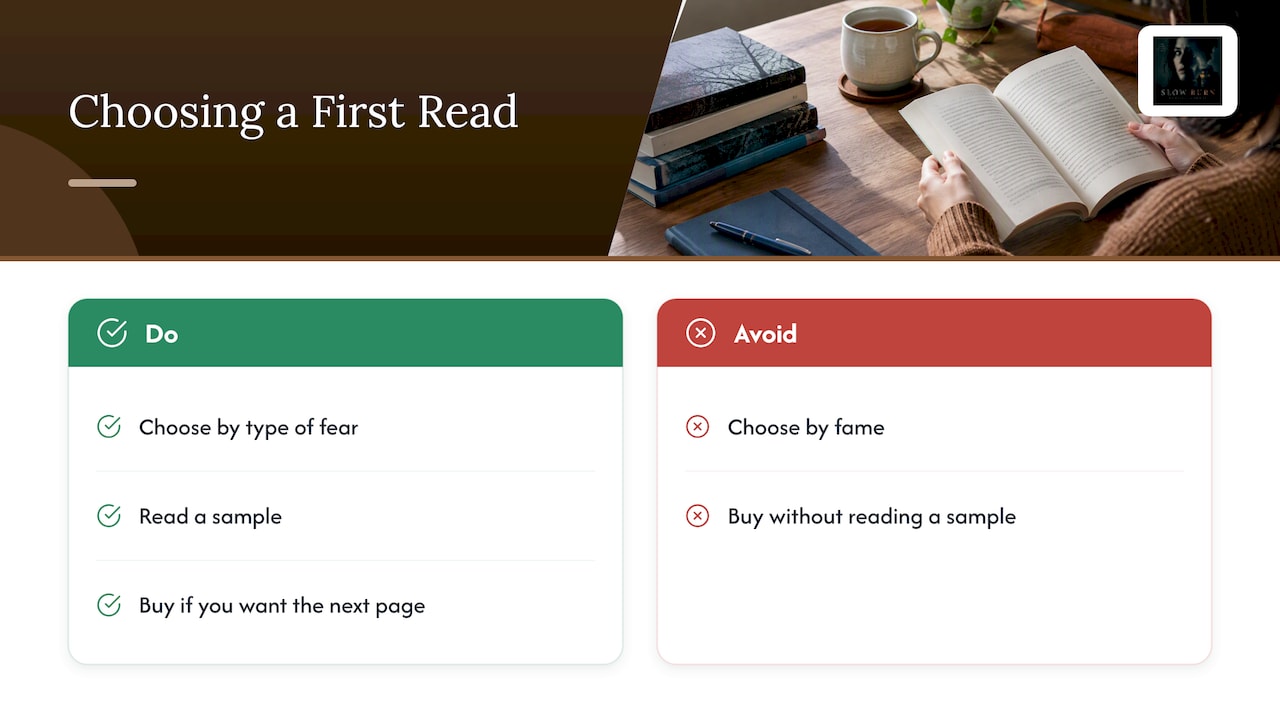
Our own advice for a first Japanese horror book is plain. Choose by the type of fear, not by fame. Read the sample. If you reach the end of the preview and want the next page, buy it. If you don’t, you have lost ten minutes, not ten dollars.
We do not claim Japanese authors are the answer to every horror itch. Some readers find the slow burn is not for them, and that is fine. The same thing that makes J-horror great, patient dread, is what makes other quiet subgenres worth a look too.
— lorraine
Where to go next if you like slow, atmospheric dread
If the quiet, psychological quality of these books is what hooked you, these related guides will take you further:
- Psychological horror books, sorted by mood, with preview chapters, for readers who want fear that lives in the mind.
- Short horror story collections you can preview first, a good match if Goth or Ugetsu Monogatari appealed to you.
- Gothic mystery novels for haunted house fans, where houses and families carry the horror, a theme close to much J-horror.
- Folk horror books, for readers drawn to the folklore side of kaidan.
Preview a horror read before you buy
ThrillerHorrorSuspense.store sells digital horror, thriller and suspense e-books, and many of our titles let you read exclusive chapters before you purchase. That is useful when you’re trying something outside your usual pace, as Japanese horror often is.
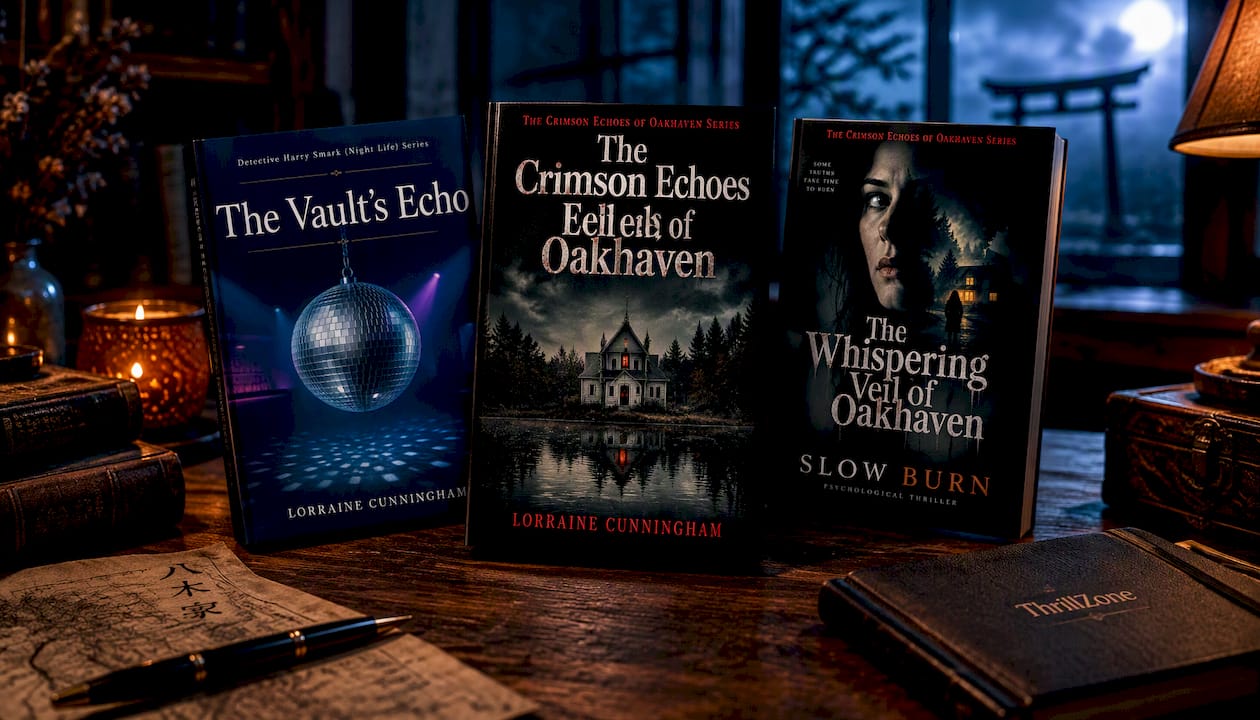
We are a focused shop, so the selection is curated around these genres rather than spread across everything. Browse the horror collection for slow-building, atmospheric reads, or the thriller collection if Out and In the Miso Soup were more your speed. If you like a haunted-place series, start with The Crimson Echoes Of Oakhaven, the first book in an original series, and read the preview chapter first.
Frequently asked questions
What is the best Japanese horror novel for beginners?
Most readers start with Ring by Koji Suzuki because it is the origin of a global phenomenon and reads quickly. If you prefer crime to the supernatural, Out by Natsuo Kirino is a strong alternative. Pick based on whether you want a curse or a crime.
Are Japanese horror novels scarier than Western horror?
They are scarier in a different way. Rather than relying on gore or sudden shocks, they build sustained atmospheric dread and tie fear to family, society and folk belief. Some readers find that more disturbing, others find it too slow.
Are the movies and the books the same?
Not quite. The Ring novel, for example, leans more on investigation and science than the films do. If you have seen the movie, the book still has surprises.
Do I need to know Japanese culture to enjoy them?
No. The books that have done best in English tend to be the ones that speak to universal fears, and good translations carry the needed context. A short introduction on kaidan helps, but it is not required.
How can I tell whether a translation is good?
Check the translator’s other work in Japanese fiction and read a sample before buying. If the opening chapter flows naturally and keeps its tension, the translation is probably doing its job.
Sources
- Japanese horror (Wikipedia)
- Modern-Day Kaidan: Japanese Horror Storytelling as Popular Culture
- Bringing Out the Horror of What He Knows Best, The New York Times
- Now That Japan Is Cool, Its Fiction Seeks U.S. Fans, The New York Times
- J-Horror in translation, Goodreads list
- Japanese Horror Fiction, Goodreads list
- Japanese Horror Books, Goodreads shelf
Recommended
- 12 Black Horror Authors to Read First, With Preview Chapters
- 15 One Sitting Horror Novellas to Read Tonight, Includes Previews
- Folk Horror Books: Classics, New Regions, and a Preview Chapter
- Preview First: 4 Survival Horror Books From Prepper to Literary